
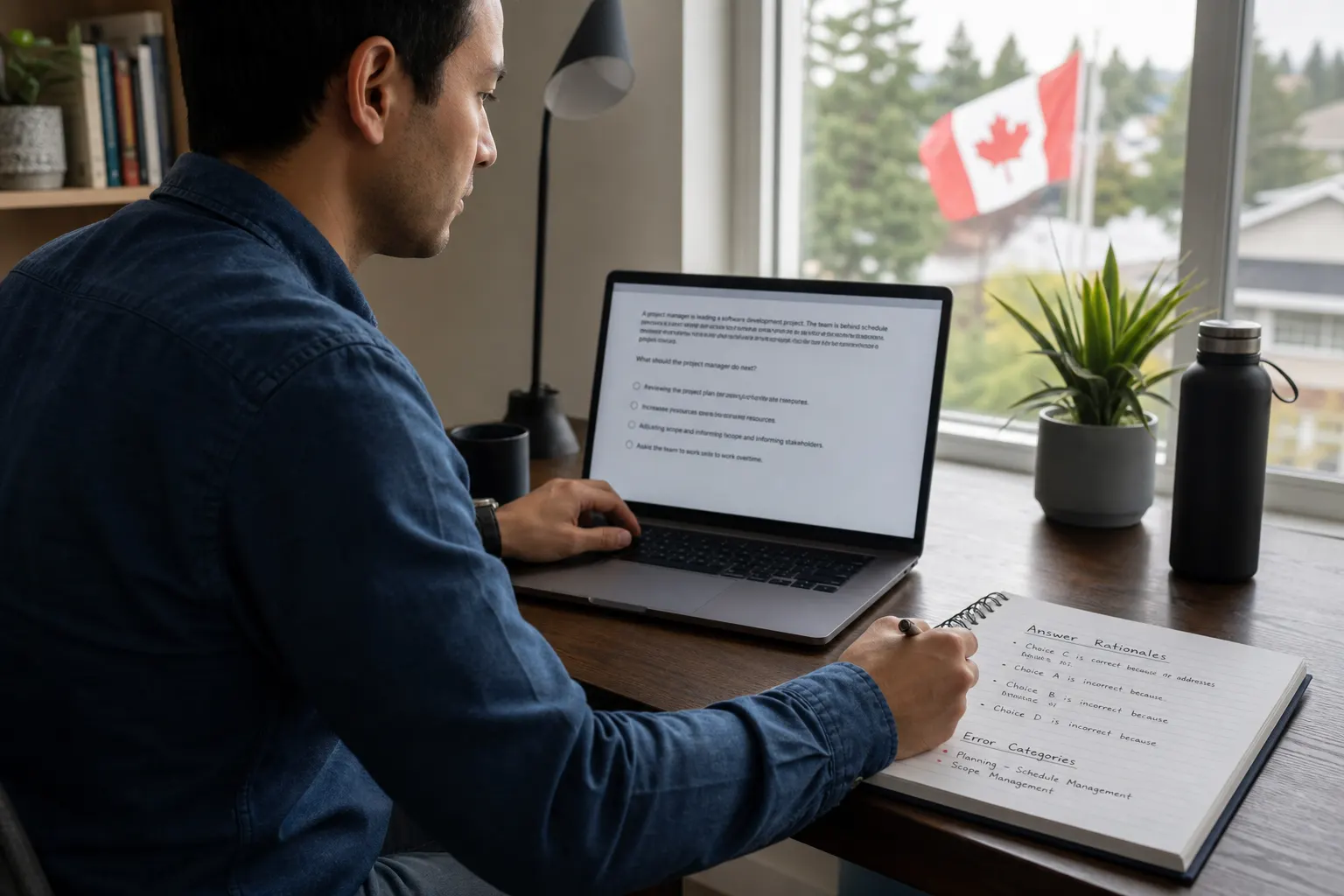
Free PMP practice questions with answers are most useful when they help you understand your mistakes, not simply produce a percentage. Before committing study time, check whether the questions match the PMP credential, reflect current expectations, present realistic project situations, and explain why each answer is correct.
The most effective approach is diagnostic: attempt a focused set, review every rationale, classify the cause of each mistake, and retest the weak area later. That process shows whether you need more knowledge, better judgement, stronger pacing, or additional support.
Quick summary

- Choose questions that are credential-specific, maintained, scenario-based, and supported by useful explanations.
- Use short sets to learn, timed blocks to build pacing, and full-length mocks to practise stamina.
- Classify mistakes as knowledge gaps, misreading, judgement errors, or timing problems.
- A practice score is a progress signal, not proof that you will pass.
- Continue self-study when your gaps are clear and improving. Consider coaching when you need accountability, application guidance, or help interpreting recurring errors.
Eight checks for choosing useful free PMP practice questions
A large question bank is not automatically a good one. Use these checks before trusting a free PMP practice test or building your study plan around it.
1. Confirm the credential and currency
Make sure the resource is designed specifically for the PMP exam rather than a general project management quiz or another PMI credential. It should identify the relevant exam expectations and show that the material is maintained as standards, terminology, and exam patterns change.
PMI terminology alone does not prove that a question set is current. Look for the preparation reference it follows, when it was reviewed, and whether the author distinguishes third-party practice from official PMI content.
2. Look for scenario-based judgement
Strong PMP practice questions ask you to interpret a project situation and choose the most appropriate response. They test how you would work with stakeholders, respond to change, address risk, support a team, or protect value. Definition questions may help with recall, but they cannot reproduce the judgement required by situational items.
Look for a useful mix of predictive, agile, and hybrid contexts. The goal is not to memorize a preferred phrase. It is to identify the problem, consider the environment, and select the action that best fits the circumstances.
3. Require explanations that teach the reasoning
An answer key that says only “B is correct” gives you little to work with. A useful rationale explains why the selected action is appropriate, why alternatives are weaker, and which principle or situation supports the decision.
Write down your reasoning before reading the explanation. Then compare your thought process with the rationale. This reveals whether you misunderstood the scenario, selected a reasonable but less appropriate action, or relied on a memorized pattern.
4. Check domain coverage and performance tracking
One overall score can hide an important weakness. Choose resources that let you review performance by relevant content area, question type, or topic. Track recurring errors rather than recording only whether each answer was right or wrong.
You may discover that you understand the concepts but struggle with stakeholder scenarios, change-related decisions, or questions involving agile teams. That pattern is more useful than a single combined percentage.
5. Match practice timing and formats to the exam
Untimed questions are valuable at the beginning because they let you concentrate on comprehension and reasoning. Timed blocks become important once you understand the material, while full-length simulations help you practise concentration, pacing, and breaks.
The supplied Education Edge material describes the PMP exam as having 180 questions, 240 minutes, 170 scored questions, 10 pretest questions, and two 10-minute breaks. Details can change, so review the PMP exam format and confirm current information with PMI before test day.
6. Verify that questions test application, not just recall
Read several sample questions before starting a large set. Ask whether each question gives enough context to make a project decision, whether more than one option initially seems plausible, and whether the explanation teaches a transferable way to reason.
Be cautious when a resource relies heavily on isolated definitions, obscure wording, or artificial tricks. Realistic practice should make you think about what to do next in a project.
7. Check the update and review process
A question bank should make it reasonably clear how its content is reviewed. A maintained repository is more useful than an old collection that happens to contain many questions. Check whether the provider refers to current exam expectations and revises explanations when guidance changes.
Questions should not be presented as copied from the real PMI exam, guaranteed predictions, or proof of a particular result unless those claims are independently verified.
8. Separate practice questions from a full simulation
A short quiz and a full-length mock exam serve different purposes. A short set can help you study one topic in 20 or 30 minutes. A full simulation tests mixed content, sustained attention, uncertain answers, and time pressure.
Select the format that matches your current objective and use the result to decide what to study next.
Short sets, timed blocks, or full-length mocks?
| Practice format | Best use | How to review it |
|---|---|---|
| Short, untimed set | Learning concepts and question logic | Read every rationale and note the underlying principle |
| Timed question block | Building pacing and reducing hesitation | Record whether errors came from knowledge, judgement, reading, or time pressure |
| Full-length mock exam | Rehearsing stamina, mixed content, timing, and breaks | Review by topic and error type, not only the final score |
Education Edge describes its free resource as including five full-length practice exams with 180 questions each. These are third-party preparation materials, not official PMI exam content or a guarantee. Access the free PMP practice exams after establishing a review method.
The practice, review, and retest loop

- Attempt a focused set. Choose a manageable number of questions and note your confidence before checking answers.
- Record your reasoning. Write down what you believed the situation required and why you selected your answer.
- Read every rationale. Review explanations for correct answers as well as incorrect ones, especially when you guessed.
- Classify the error. Decide whether the problem was knowledge, misreading, judgement, or pacing.
- Study the underlying concept. Return to relevant learning material instead of memorizing an answer letter.
- Retest later. Use a new set after enough time has passed to check whether your reasoning improved.
This loop turns free PMP practice questions with answers into an active study system and prevents completing hundreds of questions without correcting recurring errors.
How to diagnose each missed question
Knowledge gaps
You have a knowledge gap when you do not understand the concept, process, role, or principle needed to answer. Use targeted study followed by a small set of related questions.
Misreading
Misreading occurs when you overlook words such as “first,” “next,” “most appropriate,” or “except.” During review, identify the action, constraint, and desired outcome in each scenario.
Judgement errors
A judgement error means you understood the words but chose an action that was reasonable without being the best response. Ask which option addresses the root issue, follows the appropriate sequence, and fits the project context.
Pacing problems
If you know the material but rush near the end, practise timed blocks and a consistent approach for uncertain questions. Do not sacrifice explanation review simply to complete more questions.
When free practice is enough, and when to add support
Self-study may be sufficient when you can identify weak areas, understand rationales, maintain a realistic schedule, and see improvement in accuracy and timing. Free practice questions can then form one part of a broader PMP exam prep plan.
Additional support may help when mistakes remain difficult to interpret, your schedule is inconsistent, or you need application guidance. Instructor-led preparation can also suit learners who benefit from accountability, live discussion, structured coverage, and post-course coaching.
Education Edge is a Canadian professional education provider and PMI Authorized Training Partner based at 120 Matheson Boulevard East in Mississauga, Ontario. Its PMP preparation includes six- to eight-week weekend cohorts, practice questions, mock exams, application guidance, and post-course coaching. For readers comparing study habits with other professional prioritization examples, inbox triage mistakes also illustrates why categorizing errors before changing a process matters.
Frequently asked questions
Can free PMP practice questions replace a full PMP preparation course?
They can support self-study, but they do not replace every part of preparation for every learner. A course may add structured coverage, instructor feedback, application guidance, accountability, and support with recurring judgement problems.
How many PMP practice questions should I complete before the exam?
There is no single number that proves readiness. Prioritize careful rationale analysis over volume. A smaller set reviewed thoroughly can be more valuable than many questions answered without correcting the underlying mistakes.
What does a low score on a free PMP practice test mean?
It means you have information to investigate, not a prediction of failure. Break the result down by topic and error type. A low score caused by unfamiliar content requires different action from one caused by misreading or running out of time.
Should I use untimed questions before taking a full-length PMP mock exam?
Usually, yes. Start untimed while learning to interpret scenarios, move to timed blocks as your reasoning becomes consistent, then use full-length mocks to practise stamina and pacing.
Use practice results to choose your next study step
Free PMP practice questions with answers are worth using when they align with the PMP credential, test judgement, provide teaching rationales, and are maintained over time. Their greatest value comes from classifying mistakes, addressing the cause, and retesting the same skill in a new context.
If your gaps are clear and improving, continue focused self-study. If errors persist or you need accountability and application guidance, compare structured preparation with your current approach. For instructor-led PMP exam prep in Mississauga and support for professionals across Canada, visit Educationedge.ca.
Education Edge is a PMI Authorized Training Partner (ATP #4456). Every course is live and instructor-led, and selected courses carry a 100% pass guarantee or your money back.